
ENERGY


Role of the CEC
The role of the CEC (Community Energy Champion) is intended to provide support to the community in reaching its energy goals, by driving and coordinating the completion of energy related initiatives within the community. It is MFN’s goal to employ a CEC that has the passion to implement the recommended actions developed through the CEP process and priorities identified by the community.
Michipicoten First Nation’s CEC is Gina Simon, who has been instrumental in brainstorming energy initiative ideas, coordinating energy programs, as well as engaging with the community in relation to energy. Gina has completed several training programs in order to enhance her skillset in the energy field.
Completed Training Programs:
- Energy Manager Training
- Energy Audit Foundation Training
Planned Training Programs:
- Energy Audit Advisor Training
- 2020 Catalyst Program
What is a CEP?
A CEP (Community Energy Plan) helps to improve energy efficiency and reduce electricity consumption at the community level. It also helps communities consider opportunities for renewable energy solutions, and can promote a greater interest, awareness, and understanding about energy planning. Community Energy Planning provides benefit in the following areas:
- Economic Development
- Health & Safety
- Environment & Climate Change
- Education & Capacity Building
- Community Independence
MFN CEP
MFN is in the process of developing a CEP through funding received by the Independent Electricity System Operator’s (IESO) Indigenous Community Energy Plan Program. MFN’s CEP is intended to be completed in 2022 and will outline the vision, goals, and recommended action items related to energy for MFN to implement. It is essential for MFN to employ a CEC to implement the recommended actions outlined in the CEP once completed, as well as to monitor the CEP to update the document as necessary.
Energy Initiatives/Programs
Energy Initiatives/Programs
Many of the energy initiatives and CEC training have been funded by the IESO’s Education & Capacity Building Program.
Current Initiatives/Programs
- Youth & Elder’s Gathering
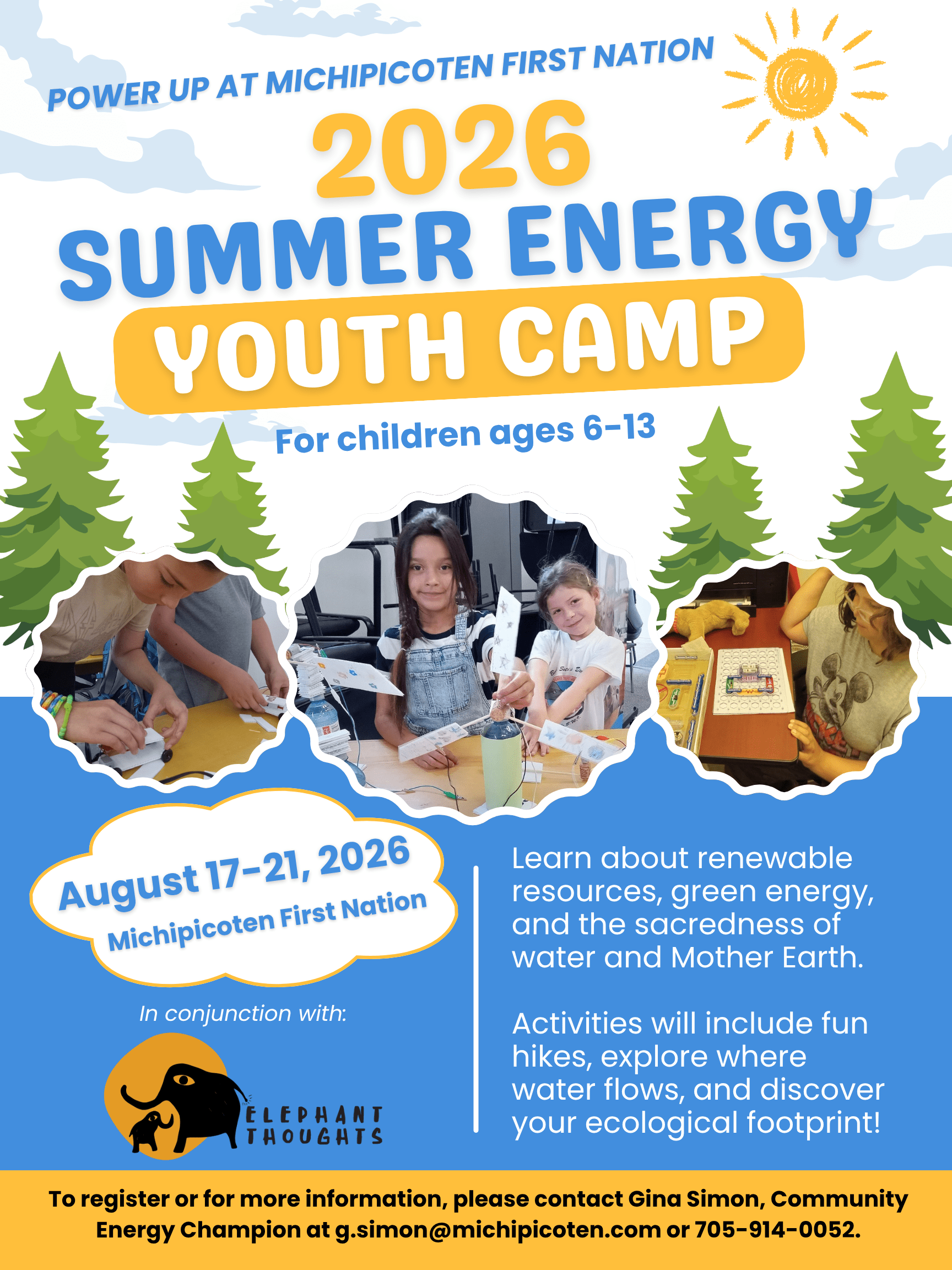
- Youth Energy Camps
- Small Business Lighting Program: received funding to assist commercial buildings in reducing electricity consumption by implementing energy efficient lighting retrofits.
Future Initiatives/Programs
- Youth Education Workshops
- Community Workshops
- Community Engagement
- Explore potential and identify funding for solar-powered streetlights
- First Nation Commercial Building Retrofit Program: MFN to apply to program offered by the IESO to install retrofits of band-owned commercial buildings aimed at reducing electrical consumption.
ENERGY SAVING TIPS
- Check vents and filters. Regular maintenance, like checking filters, on heating systems will extend the lifespan of your equipment.
- Keep your equipment free of clutter. While inspecting filters, check that furniture or other obstructions aren’t blocking your equipment.
- Caulk small holes and cracks around ducts, pipes, exhaust fans, vents, sink and bathtub drains, fireplace and under countertops.
Water
- Install water-saving showerheads and faucet aerators.
- Check your water pipes, toilets and faucets for leaks and repair any you find.
- Use the water-saving setting on your dishwasher.
- Scrape food residue off plates instead of using water to rinse.
- Shorten showers to cut hot water costs—using a timer can help you track and reduce your shower time.
- Wash and rinse laundry with cold water and only run full loads whenever possible.
- Turn off the faucet when brushing your teeth.
- Turn off the faucet when washing dishes, wet with a little water, scrub and rinse.
- Turn off the faucet when shaving.
Heating and Cooling
- Use ceiling fans to push hot air down in winter, and to keep air circulating so you feel cooler in summer.
- Clean or replace filters regularly to help your furnace, heat pump and air conditioner work at peak efficiency.
- Cover bare floors with rugs to add comfort and help retain heat, especially if there is little or no floor insulation in your home.
- Install a smart thermostat so it can adjust the temperature automatically and help you save energy all year long.
- Vacuum registers regularly and avoid blocking them with furniture and other objects to keep air flowing freely.
- Turn down the thermostat to 65-68 degrees during the day and 58-60 degrees at night during cooler months. If you have a heat pump, turn the thermostat down no more than three degrees at night. In warm weather, set your heat pump or air conditioning thermostat to 72-75 degrees.
- Heat your home in winter with help from the sun by leaving window shades or blinds open during the daytime; close window coverings at night to help keep the heat in.
- Close fireplace and wood stove dampers when not in use but wait until several hours after the fire is out and the ashes are cold.
If you have an idea or would like to learn more about any of these initiatives or programs, I would love to hear from you!
Contact:
Gina Simon, Community Energy Champion (CEC)
Phone: 705-914-0052 cell
E-mail: g.simon@michipicoten.com
Location: Family Well-Being Lodge (3 Maple Street, Wawa)
Past Energy Events & News
- 2026 Summer Energy Youth Camp | Michipicoten First Nation
- Energy Field Trip with MFN & Elephant Thoughts During March Break for Youth aged 14-18 | Michipicoten First Nation
- MFN Solar Training with NASA | Michipicoten First Nation
- Updates on Greener Homes Grant and Training Opportunities | Michipicoten First Nation
- Kids get Powered Up! at MFN Summer Youth Energy Camp 2023 | Michipicoten First Nation
- Concentrate on Conservation Workshop | Michipicoten First Nation
- Ontario Electricity Support Program (OESP) – Q&A | Michipicoten First Nation
- Energy Questionnaire Gift Card Winners & Energy Prize Bingo details
- Need Help with Electricity Bills? | Michipicoten First Nation
- Register for the Canada Greener Homes Grant | Michipicoten First Nation